

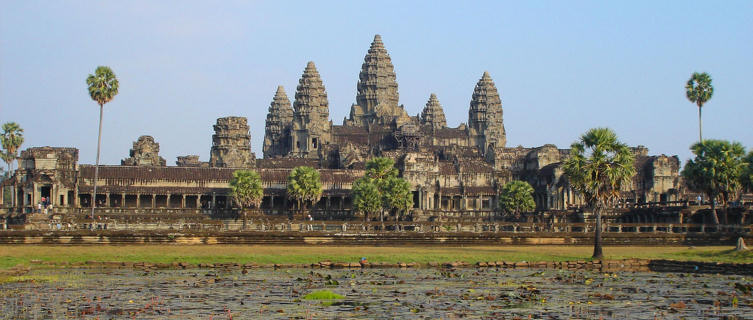
Angkor Wat reflections at sunset. © Philip Lock
Hari Kedua (tengahari) - 12/10/2016
Selepas puas bermesra dengan orang tempatan serta bergambar dengan bunga-bunga teratai di Lotus Farm tadi, akak meneruskan pula untuk visit ke Angkor Wat serta temple temple yang berdekatan dengannya seperti Ta Prohm, Bayon Temple, Angkor Thom, Terrace Of The Elephants.
Nampak gayanya kenalah meredah Angkor Wat dalam cuaca yang dah panas terik ni. Selalunya akak akan pergi ke Angkor Wat sebelum matahari terbit kerana nak tengok sunrise, tapi kali ni malas dah nak berkejar ke sana subuh-subuh tu.. bertabah je lah ye.. hehee..
Oohh..tempat beli tiket Angkor Wat ni dah berubah tempat rupanya. Dulu, tempatnya berhampiran je dengan Angkor Wat tu, tapi sekarang jauh sikit dan letaknya di bangunan baru yang ada museum sekali.


di sinilah pintu masuk ke kaunter tiket


Tiket untuk 1 hari berharga usd20.
Pekerja akan ambil gambar muka kita, lepas tu akan ditampal ke atas tiket kita tu... so, senyum lebih sikit ye.. hahahahaaa


ok, dah settle tiketnya.. jom..


Di sini lah tempat parking tuk tuk dan kita kena jalan kaki untuk sampai ke entrance depan Angkor Wat tu.
ANGKOR WAT
Angkor Wat ("City Temple") is a vast temple complex near Siem Reap, about 200 miles from the capital of Phnom Penh in Cambodia. Built in the 12th century by the king of the prosperous Khmer empire, Angkor Wat was built as a royal temple dedicated to a Hindu deity.
After the city of Angkor fell to invaders, Angkor Wat receded into the jungle but continued as a Buddhisttemple and a pilgrimage site over the centuries.
Angkor Wat is the best preserved example of Khmer architecture in Cambodia and is so grand in design that some rank it among the seven wonders of the world. It appears on the Cambodian national flag, a very rare instance of a flag incorporating an image of a building.
The "lost city" of Angkor first attracted the interest of Europeans in the 1800s after Cambodia was colonized by the French. Today, Angkor Wat continues to draw thousands of visitors anxious to see this remarkable ancient temple in the jungle.
In addition to many tourists, Buddhist monks are daily visitors to Angkor Wat, their bright orange robes making a vivid contrast with the grey stone of the temple.
History of Angkor Wat
The city of Angkor was the capital of the Khmer Empire from the 9th to the 15th centuries. The Khmer empire was one of the most prosperous and sophisticated kingdoms in the history of Southeast Asia, and its prosperity was expressed through a wide range of architecture.
The city of Angkor was founded on political and religious ideas adapted from India, and the temples of Angkor were intended as a place of worship for the king and a way for him to ensure his immortality through identification with the Hindu gods.
Angkor Wat was built by King Suryavarman II in the 12th century as a vast funerary temple that would hold his remains, symbolically confirming his permanent identity with Vishnu.
Many of the bas-reliefs in the temple depict scenes from the Ramayana and Mahabharata, Hindu sacred texts that recount the adventures of two major incarnations of Vishnu.
During its six centuries as imperial capital, Angkor went through many changes in architectural styles and in religion. The city of Angkor transferred its from the Hindu god Shiva to the Hindu god Vishnu, and finally to the Mahayana Buddhist deity Avalokitesvara.
By the late 13th century, the once frenzied pace of Angkor's architectural pursuits had begun to die down, and a more restrained type of religion was on the rise under the growing influence of Theravada Buddhism.
At the same time, Angkor and the Khmer Empire were increasingly threatened and attacked by invading armies. By the 16th century, the golden age of Angkor was over and many of the great temples began to recede into the jungle.
From the 15th to 19th centuries, Theravada Buddhist monks cared for Angkor Wat, and it is thanks to them that the temple remains mostly intact. Angkor Wat became one of the most important pilgrimage sites in Southeast Asia.
What to See at Angkor Wat
Angkor's temple architecture was heavily influenced by Indian ideas. From the earliest days of the city, Angkor had been conceived as a symbolic universe structured according to Hindu cosmology. The city was accordingly built around a central temple on a hill, which symbolized Mount Meru, the home of the gods.
The central tower of each temple also represented Mount Meru. The outer walls of the temple represented the mountains that were believed to encircle the cosmos.
The many waterways, canals and moats of Angkor served a dual purpose: they symbolized the waters of the cosmos and improved water control and rice irrigation. (source)


klik sini kalau nak tengok gambar-gambar di dalam bangunan Angkor Wat ni sebab kali ni akak dah malas nak masuk ke bahagian dalam tu.. simpan tenaga untuk masuk ke Ta Prohm nanti... hi.hiii..
meh tengok video ni kejap :)
Lepas ni, ke Ta Prohm pula...

parking tuk tuk
TA PROHM
Ta Prohm is the modern name of the temple at Angkor, Siem Reap Province, Cambodia, built in the Bayon style largely in the late 12th and early 13th centuries and originally called Rajavihara.
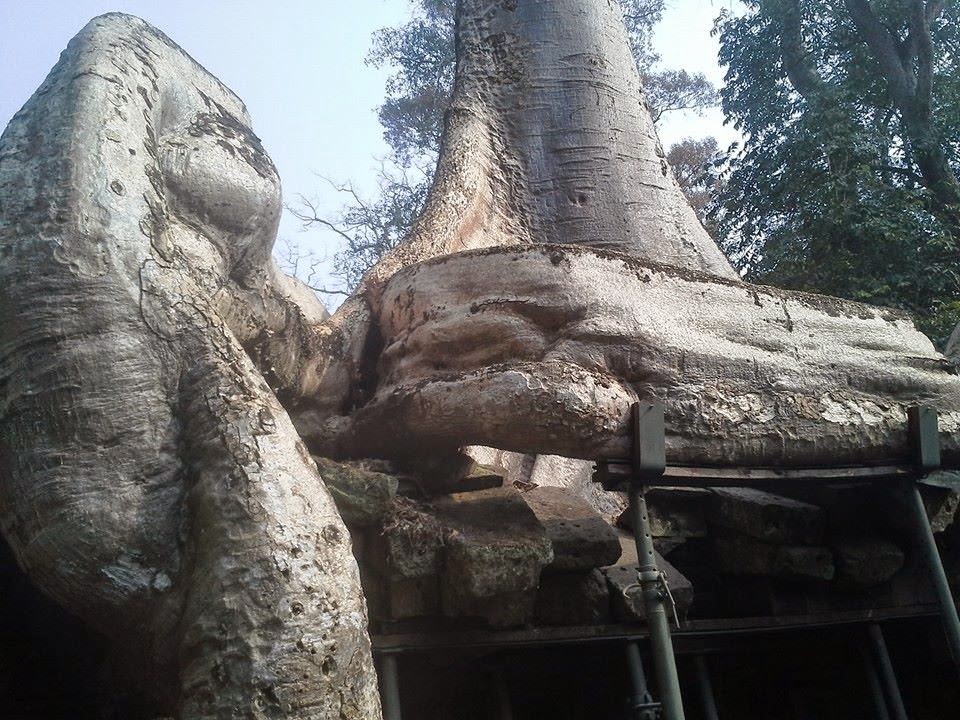
The ultimate Indiana Jones fantasy, Ta Prohm is cloaked in dappled shadow, its crumbling towers and walls locked in the slow muscular embrace of vast root systems. Undoubtedly the most atmospheric ruin at Angkor, Ta Prohm should be high on the hit list of every visitor.
Unlike most of the temples of Angkor, Ta Prohm has been largely left to the clutches of the living jungle. With its dynamic interaction between nature and man-made art, this atmospheric temple is a favorite for many - who can't help but feel a little like Indiana Jones or Lara Croft (which was filmed here) as they pick through the rubble.
What to See at Ta Prohm
Great trees tower above Ta Prohm, their leaves filtering the sunlight, providing welcome shade and casting a greenish light over the otherwordly site. Delicately carved reliefs on the walls sprout lichen, moss and creeping plants.
Some as wide as an oak tree, the vines at Ta Prohm cleave massive stones in two and spill over the top of temple ramparts. The effect is striking, especially at the strangulating root formation on the inside of the easternmost gopura (entrance pavilion). Another popular site is the "Tomb Raider tree" in the central sanctuary, where Angelina Jolie picked a jasmine flower and was sucked beneath the earth. (source)


BAYON TEMPLE
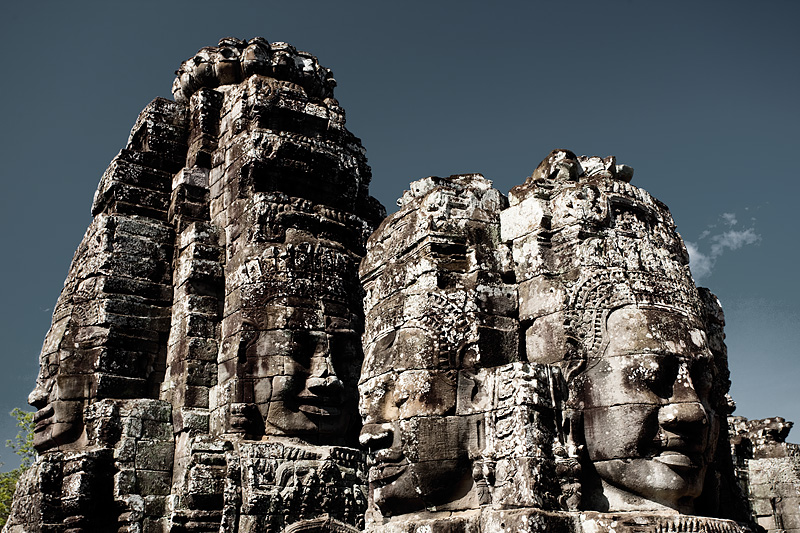
The Bayon is a well-known and richly decorated Khmer temple at Angkor in Cambodia. Built in the late 12th or early 13th century as the official state temple of the Mahayana Buddhist King Jayavarman VII.
Bayon Temple is the spectacular central temple of the ancient city of Angkor Thom. The complex is located just to the north of the famous Angkor Wat.
History of Bayon Temple
Built around 1190 AD by King Jayavarman VII, Bayon is a Buddhist temple but it incorporates elements of Hindu cosmology.
What to See at Bayon Temple
Angkor Thom was built as a square, the sides of which run exactly north to south and east to west. Standing in the exact center of the walled city, Bayon Temple represents the intersection of heaven and earth.
Bayon is known for its huge stone faces of the bodhisattva Avalokiteshvara, with one facing outward and keeping watch at each compass point. The curious smiling image, thought by many to be a portrait of Jayavarman himself, has been dubbed by some the "Mona Lisa of Southeast Asia." There are 51 smaller towers surrounding Bayon, each with four faces of its own.
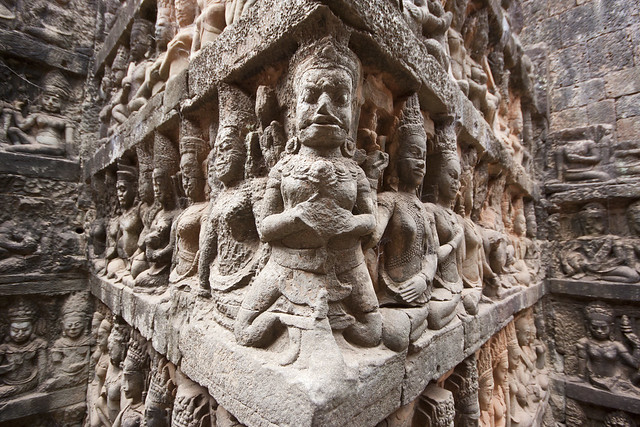
Bayon Temple is surrounded by two long walls bearing an extraordinary collection of bas-relief scenes of legendary and historical events. In all, there are are total of more than 11,000 carved figures over 1.2km of wall. They were probably originally painted and gilded, but this has long since faded. (source)


The Terrace of the Elephants is part of the walled city of Angkor Thom, a ruined temple complex in Cambodia. The terrace was used by Angkor's king Jayavarman VII as a platform from which to view his victorious returning army.

Angkor Thom means "the great city" in Khmer. Located in present-day Cambodia, was the last and most enduring capital city of the Khmer empire. It was established in the late twelfth century by King Jayavarman VII.


dah habis tour.. itu pun ada yang skip je..
penat gilerr sebab terlampau panas...
oh ye.. nasi ayam yang dibekalkan oleh Mr.S pagi tadi, tak sempat pun akak makan, cuma sempat makan kuih cakoi je... so, bawak balik dan makan di hotel je lah nasi ni nanti.

jom balik.. nak rehat..
--> [Next] <--
penat gilerr sebab terlampau panas...
oh ye.. nasi ayam yang dibekalkan oleh Mr.S pagi tadi, tak sempat pun akak makan, cuma sempat makan kuih cakoi je... so, bawak balik dan makan di hotel je lah nasi ni nanti.

jom balik.. nak rehat..
--> [Next] <--












.jpg)

